The phrase ion meaning in text has become one of the most searched slang explanations in modern digital communication. If you’ve seen someone type “ion” in a chat and felt confused, you’re not alone 😅.
This simple-looking word is actually a shorthand expression widely used in texting, especially among Gen Z users on social media platforms.
In this detailed guide, we will break down everything about ion meaning in text, including its origin, real-life usage, examples, and how it differs from formal English. By the end, you’ll confidently understand and even use it in conversations like a pro 💬.
Whether you’re scrolling through TikTok comments, Snapchat chats, or Instagram DMs, the slang term “ion” appears frequently.
What Does Ion Mean in Text?
The most common ion meaning in text is a slang contraction of “I don’t”. It is used in informal conversations to quickly express disagreement, denial, or lack of knowledge.
Instead of typing “I don’t know,” people often write “ion know.” Instead of “I don’t care,” they type “ion care.” This shortcut makes chatting faster and more casual.
💡 Example: “Ion know what happened last night 😭” = “I don’t know what happened last night.”
This slang is part of a broader internet language evolution where users prefer shorter, faster expressions. The keyword ion meaning in text mainly refers to this informal contraction used in digital communication.
Origin of Ion Slang
The origin of ion meaning in text comes from African American Vernacular English (AAVE), where spoken language often merges words for smoother pronunciation. “I don’t” naturally sounds like “ion” when spoken quickly.
Over time, social media platforms like Twitter (X), TikTok, and Snapchat helped spread this expression globally 🌍. Today, it is widely recognized as internet slang rather than just a regional expression.
- 📱 Origin: AAVE spoken English
- 📈 Popularized by social media
- 💬 Used in informal texting culture
- 🔥 Became viral through memes and captions
Understanding the background helps clarify the ion meaning in text beyond just grammar—it’s cultural evolution in digital language.
How Ion Is Used in Chat Conversations
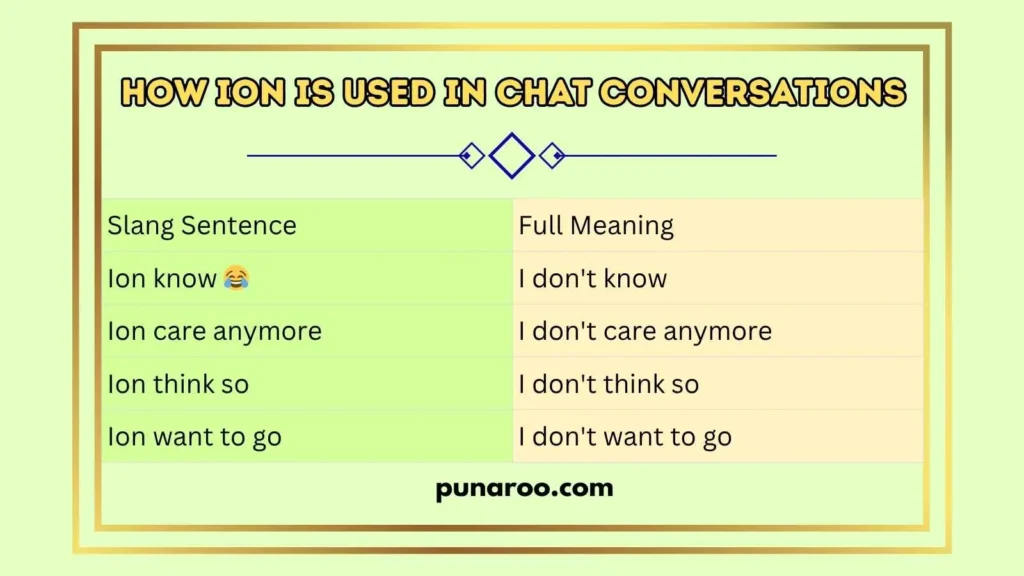
The usage of ion meaning in text varies depending on context, but it almost always replaces “I don’t.” Let’s look at some common real-world chat examples.
| Slang Sentence | Full Meaning |
|---|---|
| Ion know 😂 | I don’t know |
| Ion care anymore | I don’t care anymore |
| Ion think so | I don’t think so |
| Ion want to go | I don’t want to go |
As you can see, ion meaning in text is extremely flexible and is used in emotional, casual, and expressive conversations.
Ion vs I Don’t – Key Differences
Although ion meaning in text translates to “I don’t,” there are subtle differences in tone and usage.
- 🗣 Ion = informal, slang, conversational
- 📘 I don’t = formal and grammatically correct
For example:
Formal: I don’t understand the question.
Slang: Ion understand the question 😭
This difference shows how digital communication has evolved into a more expressive and emotional style.
Ion in Social Media Culture
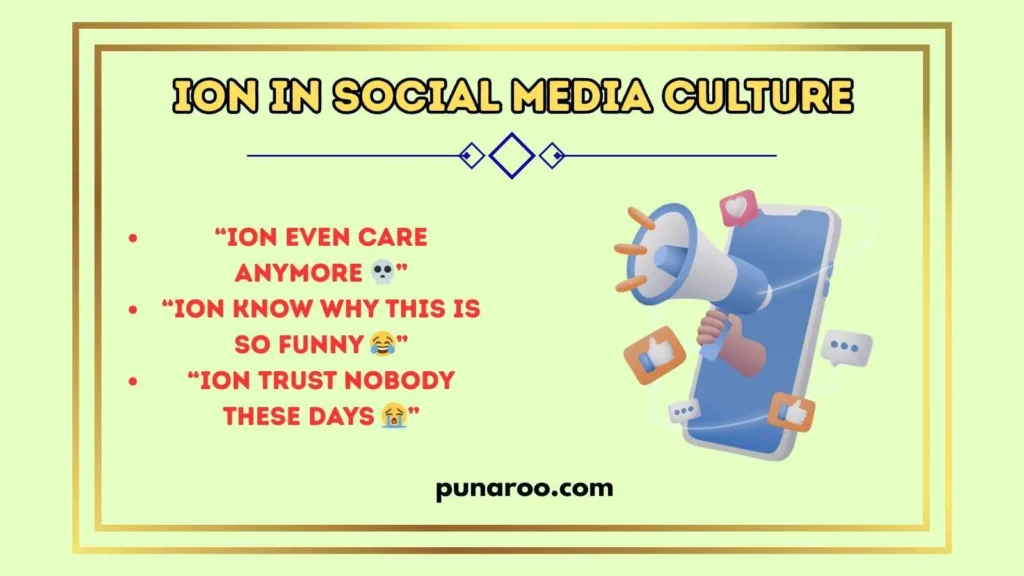
The rise of ion meaning in text is strongly connected to social media culture. Platforms like TikTok and Instagram have made slang terms viral in seconds 📲.
Creators often use “ion” in captions to make content relatable and casual. For example:
- “Ion even care anymore 💀”
- “Ion know why this is so funny 😂”
- “Ion trust nobody these days 😭”
This slang gives posts a more authentic and emotional tone, making it feel real and unfiltered.
Different Meanings of Ion (Text vs Science)
Interestingly, ion meaning in text is completely different from its scientific definition. In chemistry, an ion is a charged atom or molecule ⚛️.
Let’s compare both meanings:
| Context | Meaning |
|---|---|
| Text slang | I don’t (informal expression) |
| Chemistry | Atom or molecule with electric charge |
So when someone searches ion meaning in text, they are almost always referring to the slang version, not science.
Common Misunderstandings About Ion
Many people misinterpret ion meaning in text because it looks like a scientific term. Here are some common confusion points:
- ❌ Thinking it is related to electricity
- ❌ Assuming it is a typo of “iron”
- ❌ Believing it is a new word instead of slang
In reality, “ion” is simply a relaxed way of writing “I don’t” in casual conversations.
Why Gen Z Uses Ion So Much
The popularity of ion meaning in text among Gen Z comes from speed, expression, and identity. Younger generations prefer short, emotional, and fast communication styles.
Reasons include:
- ⚡ Faster typing in chats
- 🎭 Emotional expression
- 📱 Influence of TikTok trends
- 💬 Casual communication style
This slang is part of a larger internet language evolution that keeps changing every year.
Similar Slang Terms Like Ion
To better understand ion meaning in text, it helps to compare it with other popular slang terms:
- idk = I don’t know
- ikr = I know right
- fr = for real
- smh = shaking my head
These abbreviations are part of the same digital slang ecosystem that makes online communication faster and more expressive.
How to Reply When Someone Says Ion
If someone uses ion meaning in text in a conversation, your reply depends on context. Here are some examples:
- 💬 “Ion know” → “Same here 😭”
- 💬 “Ion care” → “Why though?”
- 💬 “Ion think so” → “Are you sure?”
Understanding tone is important because “ion” often carries emotion like frustration, confusion, or humor.
FAQs
1. What does ion mean in text?
The ion meaning in text is a slang version of “I don’t,” used in casual conversations.
2. Is ion a real English word?
Yes, but in texting it is slang. In science, it refers to a charged atom or molecule.
3. Why do people use ion instead of I don’t?
People use it for faster typing and more expressive, informal communication.
4. Is ion formal or informal?
It is strictly informal and should not be used in professional writing.
5. Where is ion commonly used?
It is mostly used on social media platforms like TikTok, Snapchat, Instagram, and texting apps.
Final Thoughts
To sum it up, ion meaning in text is a modern slang expression that simply means “I don’t.” It reflects how language evolves in the digital world, becoming shorter, faster, and more expressive.
From social media trends to everyday chats, this slang has become a core part of online communication. Understanding it helps you stay updated with modern internet culture and improves your digital communication skills 👍.
As language continues to evolve, more slang terms like “ion” will emerge. Staying aware of these trends keeps you connected with today’s online world.

I research and explain the real meanings behind popular slang, text abbreviations, and social media terms. My writing makes online language accessible for everyone.