In today’s digital world, short words dominate conversations, and one of the most confusing yet commonly used expressions is hy meaning in text.
If you’ve ever received a message like “hy 👋” and wondered what it actually means, you’re not alone.
Many people search for hy meaning in text because this tiny two-letter word can carry multiple interpretations depending on context, tone, and platform.
This complete guide will break down everything about hy meaning in text in a simple, human, and expert way so you never feel confused in chats again 😊.
The rise of digital communication has completely changed how we talk. Instead of full sentences, we now use shortcuts like “lol,” “brb,” and “hy.” But among all these, hy meaning in text stands out as one of the most misunderstood terms.
Is it a greeting? A typo? A slang version of “hi”? Or something else entirely? The answer is: it can be all of them depending on the situation. That’s why understanding hy meaning in text is important for smooth online communication.
What Does “Hy” Mean in Text? 📱
The most common interpretation of hy meaning in text is that it is a casual or stylized version of “hi” or “hey.” People often use “hy” when they want to greet someone in a short, informal way.
However, it can also mean:
- A simple greeting (like hi 👋)
- A typing shortcut
- An intentional casual tone
- A regional texting habit
So, when someone asks about hy meaning in text, the answer is not fixed—it depends on how and where it is used.
Origin of “Hy” in Digital Communication 🧠
The origin of hy meaning in text comes from early internet chatting culture. In SMS and early messaging apps, people wanted faster ways to communicate. As a result, “hi” often became “hy” due to quick typing habits or keyboard errors.
Over time, this “mistake” turned into a common slang expression used intentionally by many users.
“Language on the internet evolves faster than traditional language rules. ‘Hy’ is a perfect example of accidental slang becoming mainstream.”
Different Interpretations of “Hy” in Text 💬
One of the reasons hy meaning in text is so widely searched is because it doesn’t have a single meaning. Let’s break it down:
1. Casual Greeting 👋
Most commonly, “hy” simply means “hi.” It is a friendly way to start a conversation.
2. Typo or Shortcut ⌨️
Sometimes users accidentally type “hy” instead of “hi,” especially when typing fast.
3. Informal Tone 😎
People sometimes use “hy” to sound more relaxed or less formal in chats.
4. Regional Usage 🌍
In some texting cultures, “hy” is more commonly used than “hi,” making it a normalized greeting.
Context Matters: How to Understand “Hy Meaning in Text” 🧩
To correctly understand hy meaning in text, you must analyze the context. The same word can mean different things in different situations.
| Message Example | Likely Meaning |
|---|---|
| “Hy 😊 how are you?” | Friendly greeting |
| “Hy” (no emoji, no context) | Neutral or casual hi |
| “Hy??? why didn’t you reply” | Frustration or attention-seeking |
As you can see, hy meaning in text is highly flexible depending on tone and emotion.
Examples of “Hy” in Real Conversations 💬
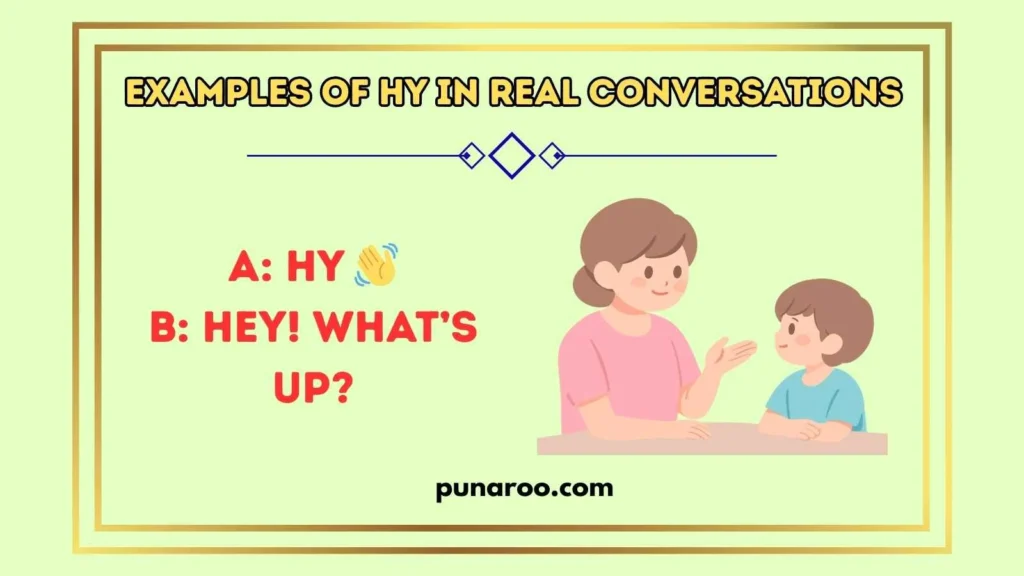
Let’s look at how hy meaning in text appears in real chats:
- A: Hy 👋
B: Hey! What’s up? - A: Hy
B: Hi, long time no see! - A: Hy bro 😎
B: Yo!
These examples show how flexible and informal this greeting can be.
Hy vs Hi vs Hey: What’s the Difference? ⚖️
Understanding hy meaning in text becomes easier when compared with similar words.
| Word | Formality | Usage |
|---|---|---|
| Hi | Neutral | Standard greeting |
| Hey | Casual & friendly | Common in chats |
| Hy | Very informal | Short/slang version of hi |
So, hy meaning in text is essentially the most relaxed version of all greetings.
Where Is “Hy” Commonly Used? 📲
The usage of hy meaning in text varies across platforms:
- WhatsApp: Quick casual chats
- Instagram: DM conversations
- Snapchat: Fast-paced messaging
- Facebook Messenger: Friendly greetings
Across all platforms, hy meaning in text remains consistent as a casual greeting.
Psychology Behind Using “Hy” 🧠
Interestingly, hy meaning in text also reflects user behavior. People who type “hy” often prefer:
- Quick communication ⏱️
- Informal tone 😌
- Low-effort texting habits
It reduces effort while still maintaining social interaction, which is why it is so popular.
Common Misunderstandings About “Hy” ❌
Many people misinterpret hy meaning in text. Here are common mistakes:
- Thinking it is rude (it’s not)
- Assuming it has a secret meaning
- Confusing it with slang from other languages
In reality, hy meaning in text is usually harmless and friendly.
How to Respond When Someone Says “Hy” 💡
If someone texts you “hy,” here are simple responses:
- “Hi 😊 how are you?”
- “Hey! What’s up?”
- “Hello 👋 nice to see you!”
Understanding hy meaning in text helps you respond naturally without confusion.
Is “Hy” Correct English? 📘
Technically, hy meaning in text is not standard English. However, in informal digital communication, it is widely accepted.
So while it may not appear in formal writing, it is perfectly normal in texting culture.
Future of “Hy” in Digital Chats 🚀
The future of hy meaning in text looks stable. As long as people use shortcuts in messaging, “hy” will continue to exist.
However, newer slang like emojis and AI-assisted messaging may slowly reduce its usage over time.
FAQ:
1. What does hy mean in text?
Hy meaning in text usually refers to a casual version of “hi” used in informal conversations.
2. Is hy rude in chatting?
No, it is not rude. It is simply an informal greeting.
3. Why do people write hy instead of hi?
People use “hy” due to fast typing habits or casual texting style.
4. Is hy slang or typo?
It can be both. Originally a typo, it is now widely used as slang.
5. Can I use hy in formal messages?
No, it is better to use “hi” or “hello” in formal communication.
Conclusion:
To summarize, hy meaning in text is a simple yet flexible greeting used in digital communication.
It mainly represents a casual version of “hi,” but its meaning can change based on tone, context, and platform.
Understanding hy meaning in text helps you communicate better, avoid confusion, and respond naturally in chats. It may look small, but it plays a big role in modern online conversations.

I research and explain the real meanings behind popular slang, text abbreviations, and social media terms. My writing makes online language accessible for everyone.